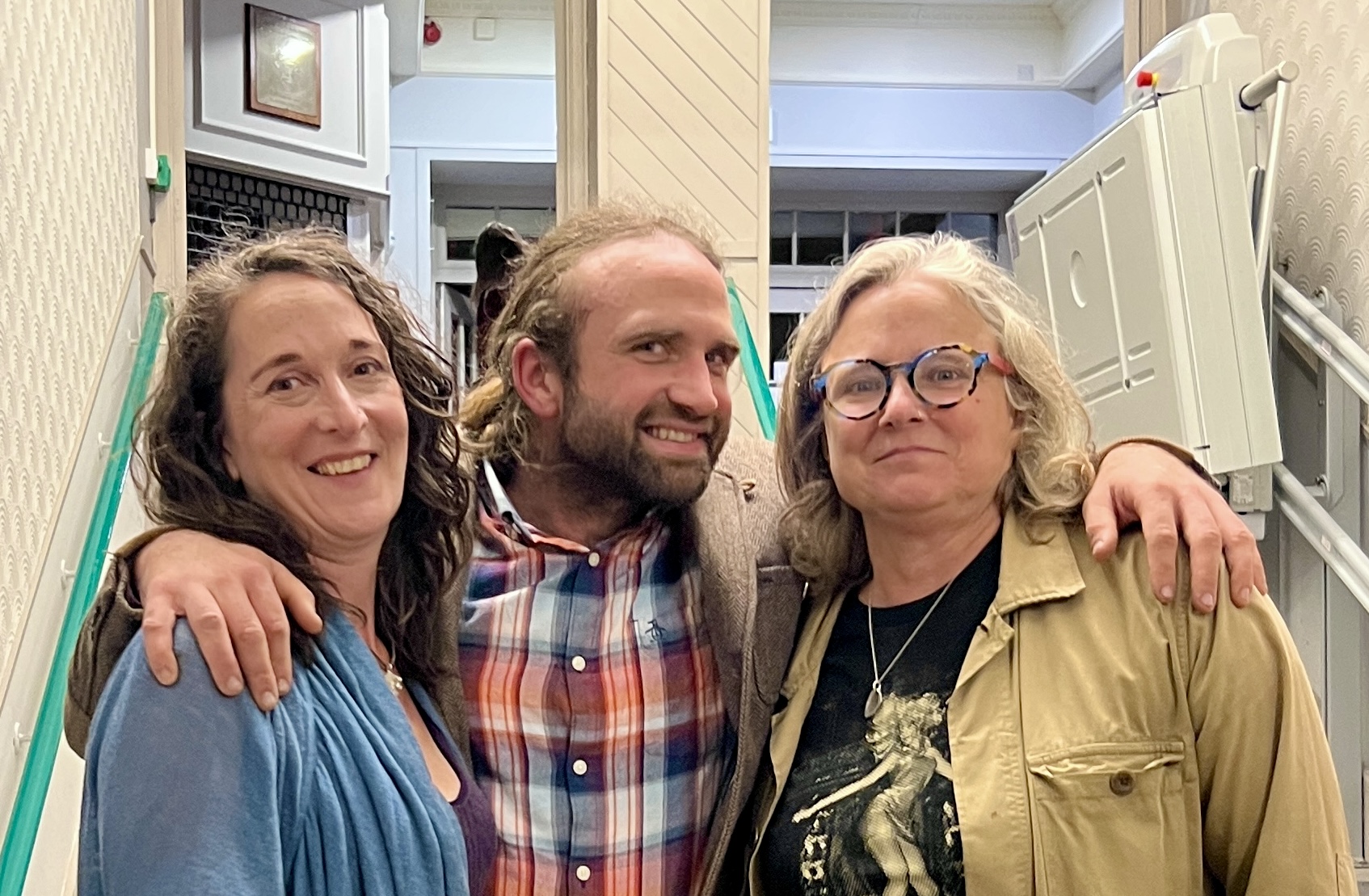
Yesterday I had the pleasure of sitting on a panel here in Carmarthen with Jen from Cegin y Bobl and Mary Sherwood, hosted by Owen from LocalMotion.
It was only meant to be a short conversation over dinner, but we managed to cover quite a lot: food poverty, farming, education, community, culture, inequality and, perhaps most importantly, what we can actually do about some of these things here in Carmarthen.
There was something quite powerful about having those different perspectives sitting alongside each other. Jen talking about getting children cooking and understanding where their food comes from. Mary talking about the realities of poverty and why simply telling people to “eat better” completely misses the point. And me talking about what we’ve learned through The Warren and Cegin Hedyn.
They might sound like separate things, but really they’re all connected.
The moment that started Cegin Hedyn
I told the story of where Cegin Hedyn came from.
After Covid, I started noticing a change at The Warren. One day I bumped into a friend in Carmarthen who apologised for not coming into the restaurant anymore.
They said, “I just can’t afford it anymore.”
That really hit me.
Because that wasn’t why I’d opened The Warren. I didn’t want good food, local food and organic food to only be available to people who could afford to eat in a restaurant.
So the question became: how do we do this differently?
Not long afterwards I discovered that the kitchen at the Lammas Street Centre was available at a very low cost. The café that had previously operated there hadn’t reopened after Covid and suddenly there was this kitchen sitting in the middle of Carmarthen.
It felt like an opportunity.
The original idea for Cegin Hedyn was incredibly simple. I’d turn up, cook a curry, and if nobody came to help me, I knew I could probably cook enough for 50 people myself.
But there was never a day when nobody helped.
One person became two. Two became three. Three became five. And eventually it became this enormous community of volunteers, to the point where today there are sometimes more people wanting to volunteer than there are things for them to do.
Cegin Hedyn is now a pay-what-you-can-afford community canteen at the Lammas Street Centre. Anybody can walk through the door. There are no questions about your income or circumstances.
And one of the things I’m proudest of is that it doesn’t feel like a service for people who are struggling.
It just feels like somewhere you want to be.
You can feel it when you walk through the door
Owen asked me what actually happens when you walk into Cegin Hedyn.
The first word that came into my head was love.
People have said it to me before, and I feel it myself. There’s something about walking into that room that feels like being hugged.
The volunteers want to be there. They’re giving their time, their skills and their energy because they believe in what they’re doing. People sit together who might otherwise never meet. Food is cooked from scratch. Local and organic produce becomes something everybody can access rather than something reserved for people with more money.
Cegin Hedyn translates as The Seed Kitchen.
We’ve planted a seed, but it has been everyone else who has watered it and allowed it to grow.
In a society where loneliness and isolation are enormous problems, I think that might ultimately be just as important as the food.
Give children a sharp knife
Jen then talked about the brilliant work happening at Cegin y Bobl.
Their approach is not just to tell children that vegetables are good for them. They put the ingredients in front of them. They talk about where they’ve come from. They let children taste them. And then they actually let them cook.
Properly.
Sharp knives. Hot pans. Chopping. Stirring. Tasting.
Jen told us about a recent session where a group of children initially didn’t want anything to do with the vegetables being put in front of them.
Then they cooked them.
By the end, they were eating the stir-fried noodles they’d made themselves.
That difference is important.
It’s not somebody standing at the front of a classroom telling a child what they should eat. It’s giving them some ownership over food and treating them with enough respect to let them participate in making it.
Kegin y Bobl take that further by inviting families in to cook together and working with teachers, teaching assistants, cooks and other staff so food knowledge becomes part of the culture of the whole school.
And Jen kept coming back to one word which I really liked:
Delicious.
Because healthy food isn’t much use if nobody actually wants to eat it.
Poverty isn’t solved with a recipe card
Mary brought another perspective to the conversation.
Her work looks at poverty and, crucially, the lived experience of being on a low income.
One of her strongest points was that we often reduce food poverty to the price of ingredients when the reality is far more complicated.
Someone might know perfectly well how to cook.
But what happens when they’ve just finished a minimum-wage shift and they’re exhausted?
What if there’s a pile of washing-up at home?
What if there’s no money on the meter for hot water?
What if the food you’re being told you ought to eat isn’t part of your culture, your family or anything you’ve ever known?
Telling someone in that situation to make a nutritious meal from scratch doesn’t address the problem.
Mary talked about how food is tied up with dignity, identity, family and choice. If we want to change our food system, people experiencing poverty can’t simply be passive recipients of somebody else’s idea of what they ought to eat.
They have to be part of creating it.
That really resonated with me.
Choice matters
Owen picked up on something that connects all of this.
Food justice shouldn’t mean, “Here’s the food we’ve decided you’re allowed to have.”
It should mean having choices.
You can eat this.
You can eat that.
This is organic.
This was grown down the road.
You can learn how to cook it.
You can meet the person who grew it.
Maybe you can even help grow it yourself.
That is a very different relationship with food.
And I think that’s where projects like Cegin Hedyn and Cegin y Bobl become interesting. They’re small examples of what a different food culture could look like.
Not perfect answers. Not replacements for the changes needed at a much bigger level.
But actual things happening now.
Agriculture is culture
At the beginning of the discussion, Owen pointed out something very simple: right there in the word agriculture is culture.
Food isn’t just fuel.
It’s the farms surrounding Carmarthen. It’s what children learn at school. It’s the people we sit beside at a table. It’s what we cook for somebody when they’re struggling. It’s the skills passed between generations. It’s our high street, our community centres, our allotments and the pieces of land around town that could be producing something.
And that is what made yesterday’s conversation feel particularly exciting.
Because so much of this is already happening here.
We have growers producing incredible food around Carmarthen. We have people teaching children to cook. We have volunteers giving their time to community food projects. We have organisations looking seriously at poverty and inequality. We have community spaces, farms, allotments, restaurants, cooks, teachers and people who simply care about making their town better.
The question is what happens when we start joining those things together.
And now, The Warren
For me, this conversation comes at a particularly interesting moment.
The Warren is reopening.
And after everything we’ve learned over the last ten years, and particularly through Cegin Hedyn, I don’t want us simply to reopen the doors and become another restaurant again.
Yes, we’re going to serve really good food.
We’re going to work with local growers and producers. We’re going to cook seasonally. We’re going to serve natural and low-intervention wines. We’re going to pay the people working here properly.
But alongside that, we’re asking a bigger question:
What can a restaurant give back to the place it belongs to?
I don’t think we’ve got the complete answer yet.
In fact, I’d be suspicious if we pretended we did.
But yesterday was another reminder that we don’t have to work it out alone.
There are already brilliant people doing pieces of this work all across Carmarthen and Carmarthenshire.
Perhaps the most exciting thing we can do now is bring more of them around the same table.
Growers. Chefs. Schools. Community groups. Farmers. Volunteers. People experiencing poverty. Businesses. Children. Older people. People who’ve lived here forever and people who’ve just arrived.
And preferably put some really delicious food in the middle.
Because if there’s one thing the last few years have taught me, it’s that food has an extraordinary ability to bring people through the door.
What happens after they sit down together is where things can get really interesting.
A huge thank you to Owen and the LocalMotion team for bringing us together, to Mary for sharing her knowledge and challenging us to think about poverty as the complex, systemic issue it is, and to Jen and everyone at Kegin y Bobl for the brilliant work they’re doing to reconnect people with cooking and where their food comes from.
There’s a lot wrong with our food system.
But there is also an awful lot happening in Carmarthen that gives me hope about what we might build in its place.