A room full of people trying to work out how community food projects can survive and grow
When we first started planning today's Community Inspiration Day, there was one thing I really didn't want it to become: a day where a few people stood at the front talking about all the things they'd done well while everyone else sat and listened.
Community food work isn't really like that. It can be brilliant and joyful and life-changing, but it can also be messy, exhausting, financially precarious and incredibly lonely. Most of us are making things up as we go along to some degree. So the idea was always to get people in a room, share what we've learnt, be honest about what hasn't worked, and hopefully leave feeling a little less like we're all trying to solve the same problems on our own.
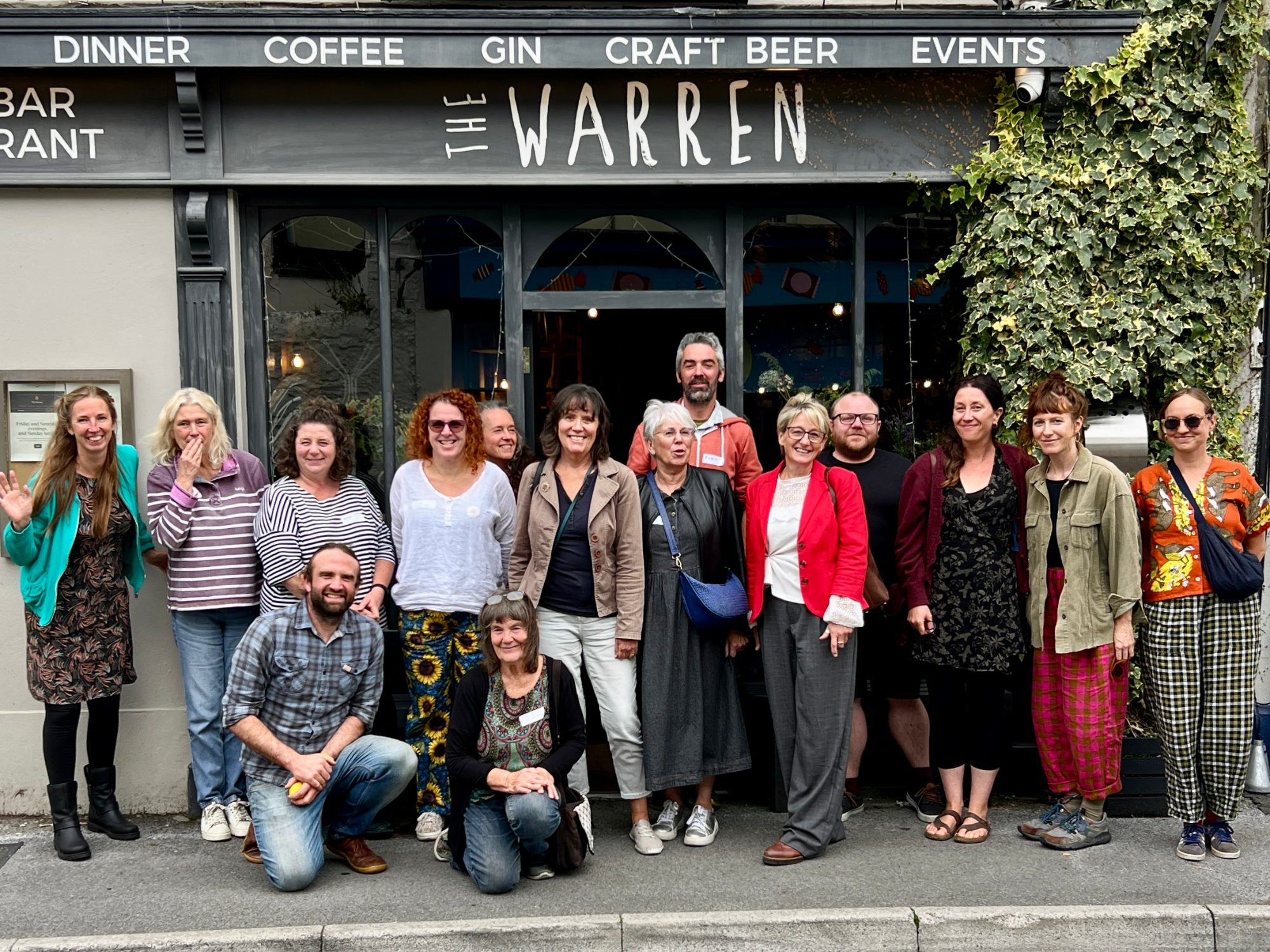
Today The Warren was full of people doing exactly that. People running community meals, village halls, community fridges, growing projects, markets, cookery sessions and local food work. Some projects are well established. Some are only just getting going. Some people are still working out what their idea might become.
I hosted the day alongside Sophie from Ein Cegin and Amie from LPIP & Aberystwyth University. Sophie and Amie have been supporting six community meal projects, and the day was really about giving those projects space to reflect on what they've already achieved, learn from each other and think about what happens next.
I talked about The Warren and Cegin Hedyn, but I was quite conscious that I didn't want to present either of them as some kind of answer. There isn't one. Every community is different and every project in the room had something to teach the rest of us.
I told the story of opening The Warren through [crowdfunding](youtube.com/watch?v=AqrAYlXRxA0&themeRefresh=1), building something I was incredibly proud of, COVID, burnout, and eventually realising that although I'd opened a restaurant because I wanted to feed people good food, that wasn't necessarily the same as feeding the whole community.
Cegin Hedyn came from that realisation. It started incredibly simply. I knew I could cook for 50 people once a week. If nobody helped me, I thought I could cook it, serve it and wash it all up myself. But somebody always did help. Someone made a cake. Someone washed up. Someone chopped vegetables. More people came, and slowly it became something much bigger than the thing I could have planned on paper. That came up a lot today: starting with what you can actually do, listening to what your community actually needs, and allowing something to grow rather than feeling you need to have the whole thing worked out before you begin.
We spent time thinking about how we tell the story of our projects. Not polished marketing language, but the actual story. Why did this start? Who does it bring together? What has changed because it exists? What are the small human moments that tell you it matters? When you're constantly doing the work, it's surprisingly easy to forget to stop and recognise what you've already achieved.
We talked a lot about volunteers. One of the simplest things I took from that was the importance of a clear ask. 'Volunteers needed' isn't actually very helpful. 'Can you come from four until six to help put out tables, chairs, flowers and glasses?' is. People want to know what they're committing to. They want to be useful. And if we're asking people to give us their time, we need to respect that time.
We also talked about money, because you can't really have an honest conversation about community food without talking about money. Grants, donations, pay-what-you-can, fixed prices, staff costs, buildings, ingredients, growers, surplus food and how you keep something accessible without burning out the people making it happen.
One thing I've learnt is that community doesn't have to mean everything is free. Sometimes the commercial bit is exactly what allows the community bit to exist. That's a big part of the experiment we're doing at The Warren now. We've reopened commercially at the weekends because this building needs to be financially sustainable. We need to pay people properly, buy good ingredients and create a business that doesn't destroy the people running it. But the reason I'm trying so hard to make that work is because I want the rest of the week to have room for other things: volunteering, community food, preserving, growing, learning, collaborations and ideas we probably haven't thought of yet.
In many ways The Warren is right back at the beginning too. I'm not standing outside these conversations with a finished project. We're experimenting again. We've got a big mountain to climb, just like a lot of the people in the room today. And that was probably the most important thing I took from the day. We are all at different stages, but we're trying to do many of the same things: connect people, make good food more accessible, support local food systems, reduce isolation, build resilience and create places where people actually want to be together.
Someone described it today as dropping pebbles into water. Every project makes a ripple. The more pebbles there are, the more those ripples start crossing over and creating movement together. I loved that. Because today didn't feel like a training course. It felt like a gathering of people trying to work out how community food projects can survive and grow, and realising we don't have to work it all out separately.
I also meant what I said at the end of the day. The Warren is currently empty Monday to Wednesday. If somebody in that room, or anyone reading this, has an idea for a community food project, a workshop, a collaboration, a meal, something involving growers, cooks, producers or people coming together around food, get in touch. The whole point of reopening this place is for it to be useful.
Thank you to Sophie, Amie, everyone who came and shared so openly, and everyone who helped make today happen. I came away with practical ideas, but more importantly I came away feeling stronger about the work we're all trying to do.
There is a lot to figure out. But there are also a lot of us figuring it out.